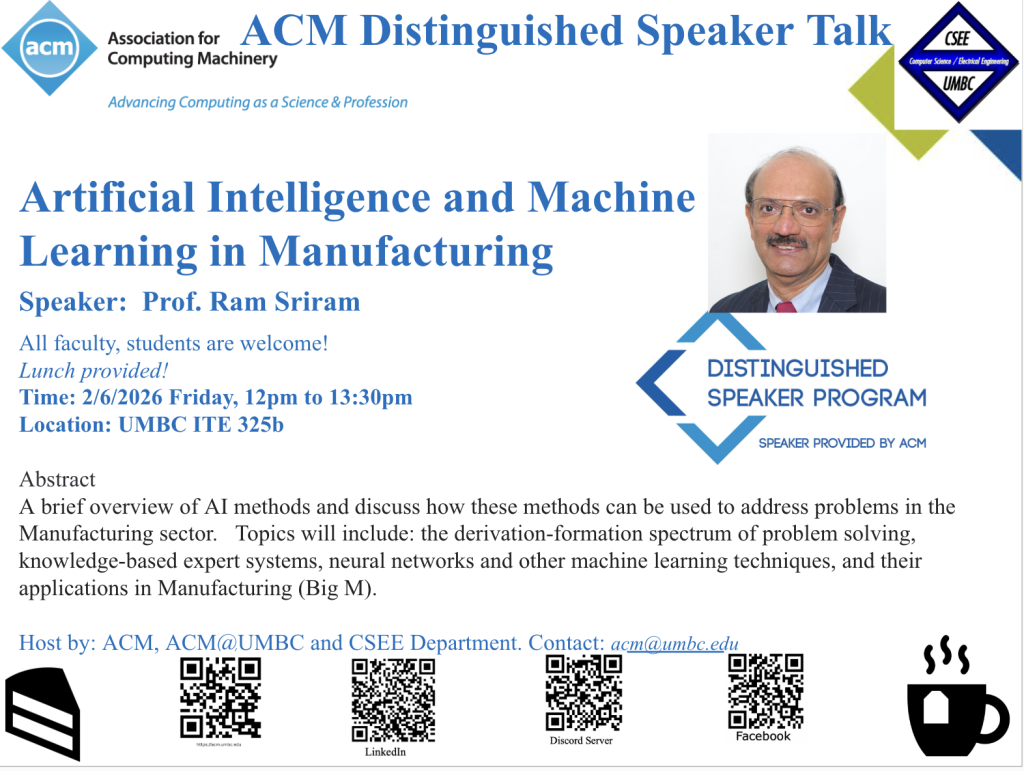
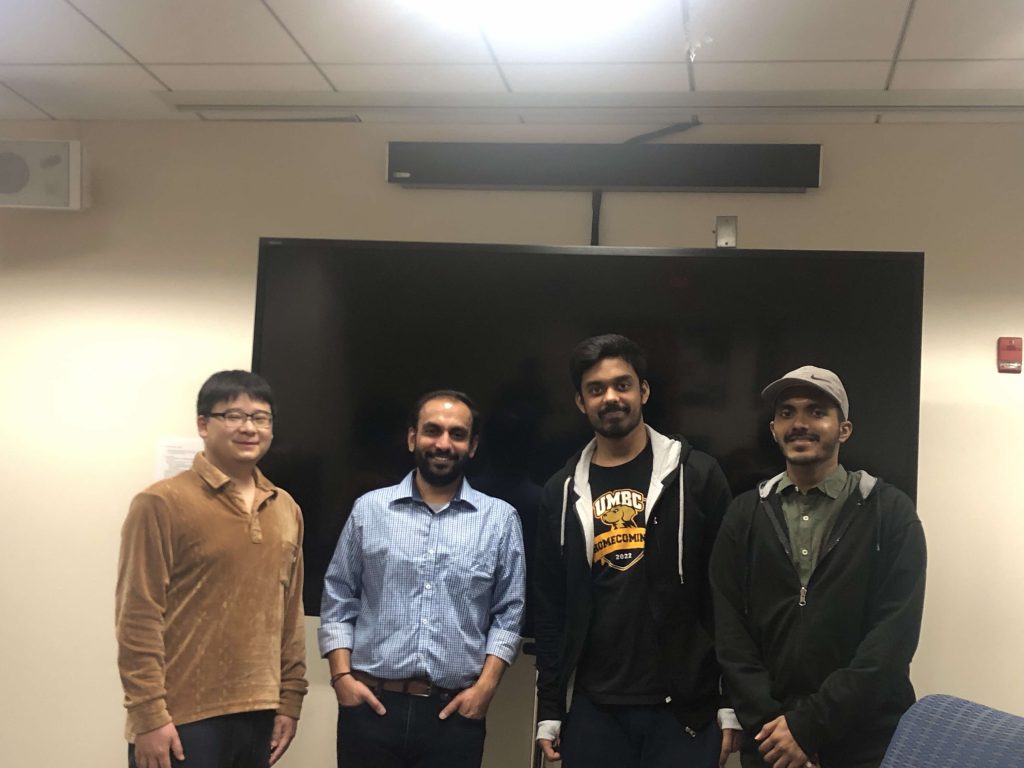
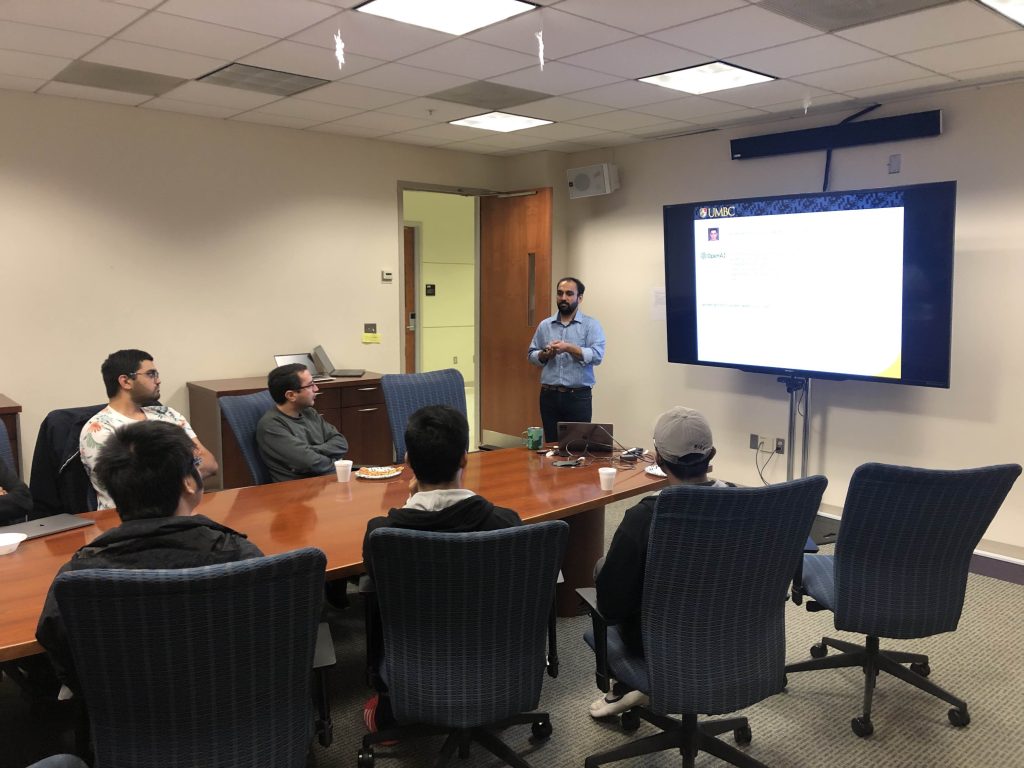
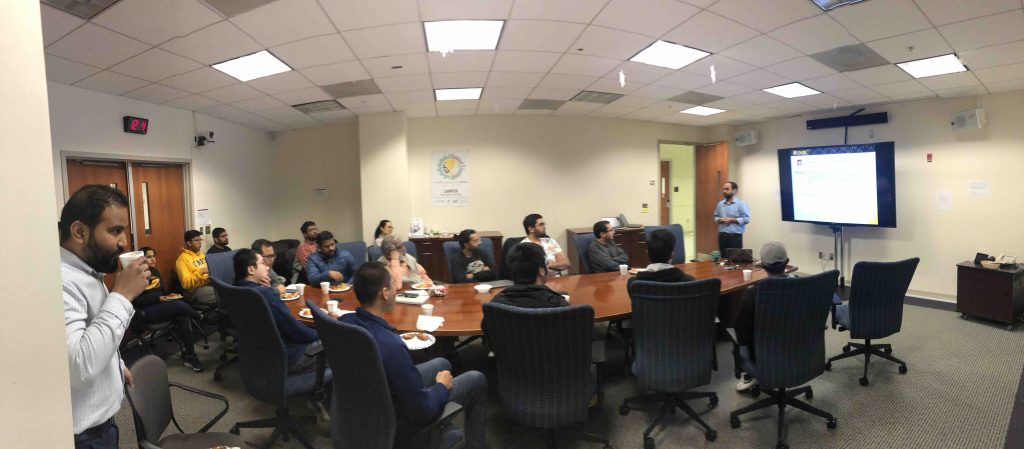
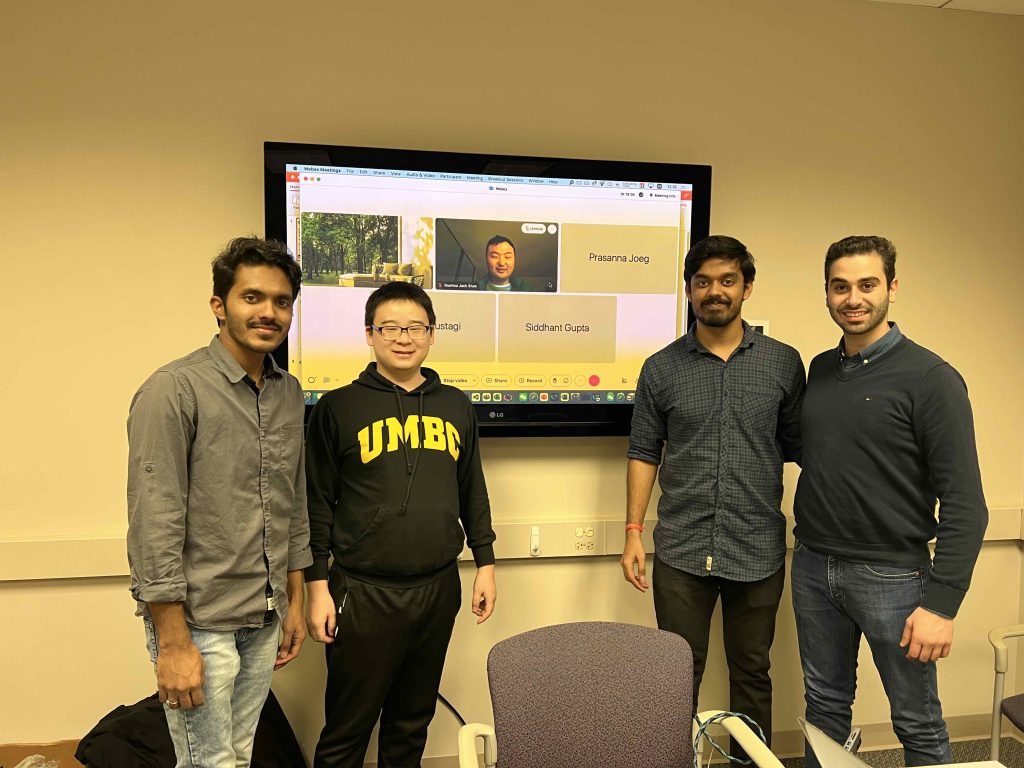
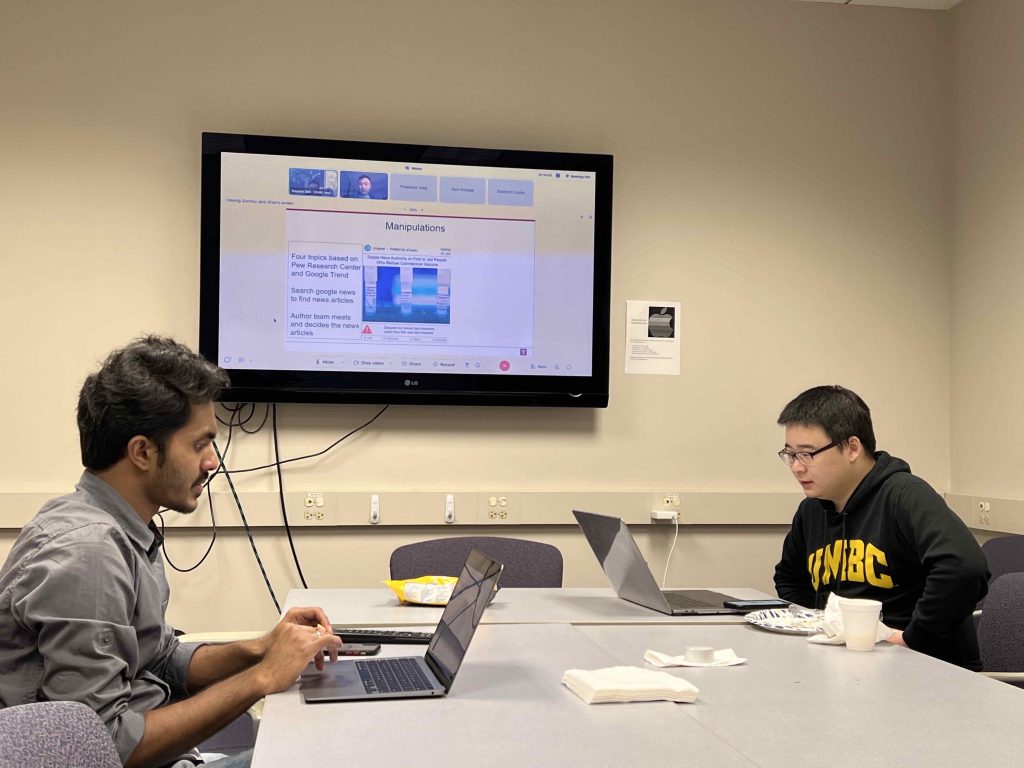
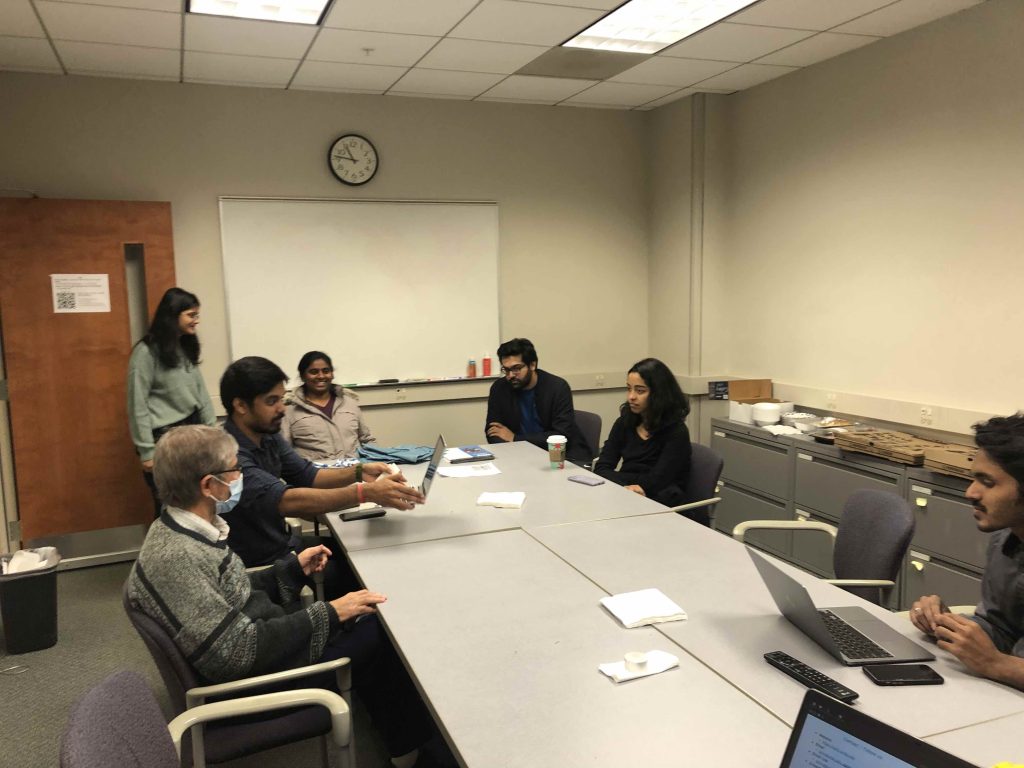
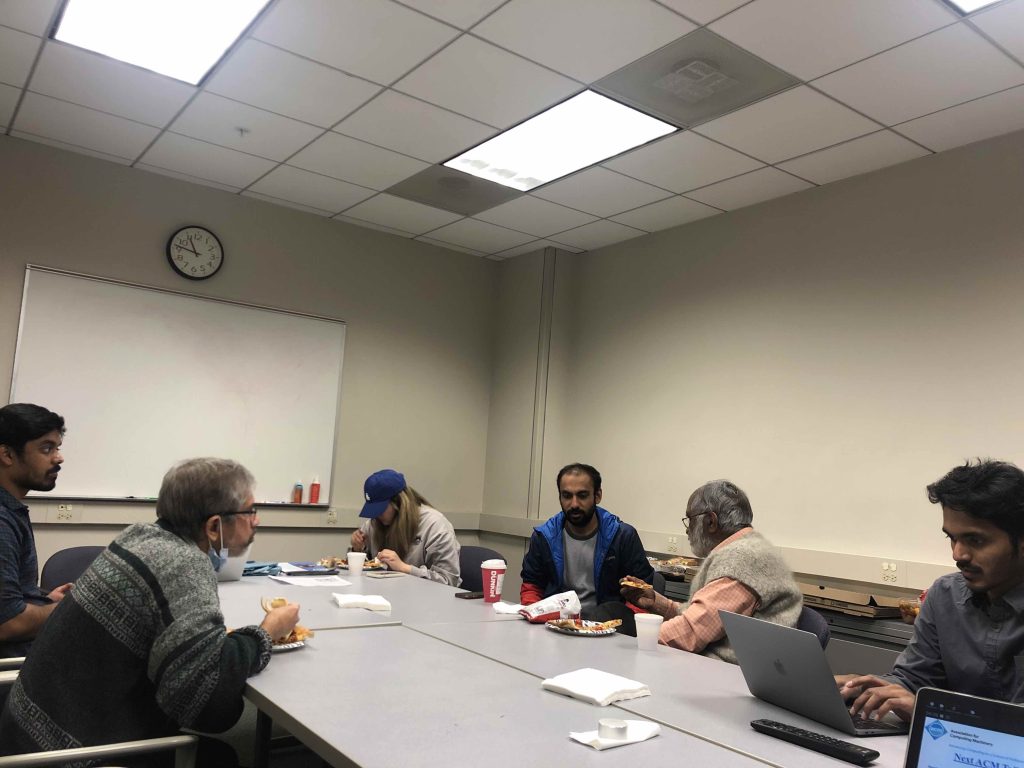
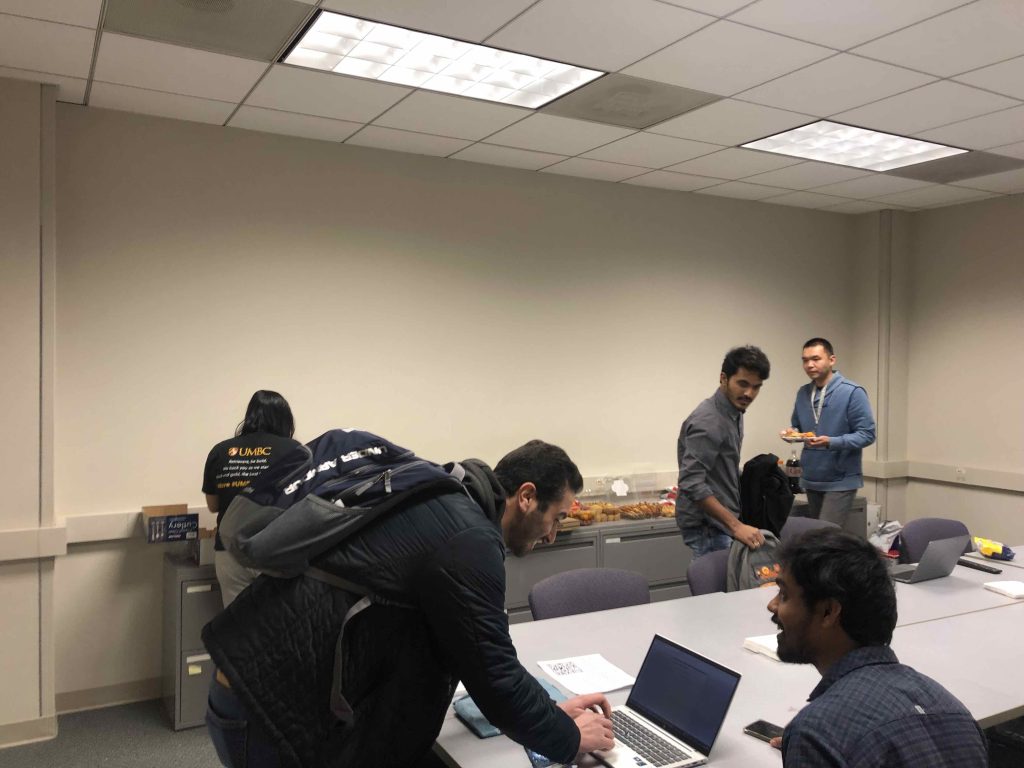
We’re excited to share that UMBC ACM’s Distinguished Speaker Talk with Prof. Ram Sriram — held on Friday, February 6, 2026 — has been featured in ACM’s official Chapter Newsletter, a global roundup of ACM student chapter activities.
In the talk, “Artificial Intelligence and Machine Learning in Manufacturing: An Overview,” Prof. Sriram — Chief of the Software & Systems Division at NIST — walked the audience through the evolution of AI, from early knowledge-based systems to modern machine learning and emerging hybrid approaches. The session drew an engaged crowd and a lively Q&A.
Being included in the newsletter is a great recognition of our chapter’s work, and we’re proud to see UMBC ACM among student chapters featured worldwide.
Location: UMBC ITE 346 or https://umbc.webex.com/meet/wtan1
Lunch provided!
Speaker: ACM Distinguished Speaker Dr. Ashutosh Dutta
Ashutosh Dutta
Systems Optimization in Mobility Management
Abstract
As mobile networks continue to grow and converge with the Internet, new wireless devices and their use are outnumbering the use of fixed network. Mobility management needs to meet the requirements of existing and emerging network technologies and applications. It may be supported in different layers of the network protocol stack. At the IP layer, Mobile IP, an IP-based mobility management, has the advantage of being applicable in any IP-based network, but is faced with many deployment challenges. Numerous variants of Mobile IP have been proposed to address these challenges in different network environments. Research in mobility management has become more active, especially with the mobile networks continuing to evolve from hierarchical towards more flattened network and densification of wireless networks. This talk presents the basics, recent advances, and future directions for mobility protocols at various layers (e.g., network, transport and application). This talk then provides taxonomy of existing mobility protocols, illustrates an abstract mobility model that can be used to support various handoff scenarios. Various handoff optimization methodologies will be explained supported by experimental and simulation results. This talk cites a few deployment scenarios to describe applicability of mobility protocols to various network environments. Many of the systems optimization techniques and mobility models discussed here can be used to provide seamless handoff support for 5G networks. Finally, the talk goes through the best practices for mobility management and provides some research directions.
Bio:
Ashutosh Dutta is currently senior scientist and 5G Chief Strategist at the Johns Hopkins University Applied Physics Laboratory (JHU/APL). He is also a JHU/APL Sabbatical Fellow and adjunct faculty at The Johns Hopkins University. Ashutosh also serves as the chair for Electrical and Computer Engineering Department of Engineering for Professional Program at Johns Hopkins University. His career, spanning more than 30 years, includes Director of Technology Security and Lead Member of Technical Staff at AT&T, CTO of Wireless for NIKSUN, Inc., Senior Scientist and Project Manager in Telcordia Research, Director of the Central Research Facility at Columbia University, adjunct faculty at NJIT, JHU, and Computer Engineer with TATA Motors. He has more than 90 conference and journal publications, three book chapters, and 31 issued patents. Ashutosh is co-author of the book, titled, “Mobility Protocols and Handover Optimization: Design, Evaluation and Application” published by IEEE and John & Wiley.
As a Technical Leader in 5G and security, Ashutosh has been serving as the founding Co-Chair for the IEEE Future Networks Initiative that focuses on 5G standardization, education, publications, testbed, and roadmap activities. He also serves as IEEE Communications Society’s Distinguished Lecturer for 2017-2020. Ashutosh has served as the general Co-Chair for the premier IEEE 5G World Forums and has organized 65 5G World Summits around the world. Ashutosh served as 2020 TPC Co-Chair and currently serves as 2021 General Co-Chair for ACM/IEEE COMSNETS and served as Finance co-chair for 2007 ACM CoNEXT conference. Ashutosh serves as an ACM Distinguished Speaker. Ashutosh served as the chair for IEEE Princeton / Central Jersey Section, Industry Relation Chair for Region 1 and MGA, Pre-University Coordinator for IEEE MGA and vice chair of Education Society Chapter of PCJS. He co-founded the IEEE STEM conference (ISEC) and helped to implement EPICS (Engineering Projects in Community Service) projects in several high schools. Ashutosh has served as the general Co-Chair for the IEEE STEM conference for the last 10 years. Ashutosh served as the Director of Industry Outreach for IEEE Communications Society from 2014-2019. He was recipient of the prestigious 2009 IEEE MGA Leadership award and 2010 IEEE-USA professional leadership award. Ashutosh currently serves as Member-At-Large for IEEE Communications Society for 2020-2022. Ashutosh obtained his BS in Electrical Engineering from NIT Rourkela, India; MS in Computer Science from NJIT; and Ph.D. in Electrical Engineering from Columbia University, New York under the supervision of Prof. Henning Schulzrinne. Ashutosh is a Fellow of IEEE and senior member of ACM.
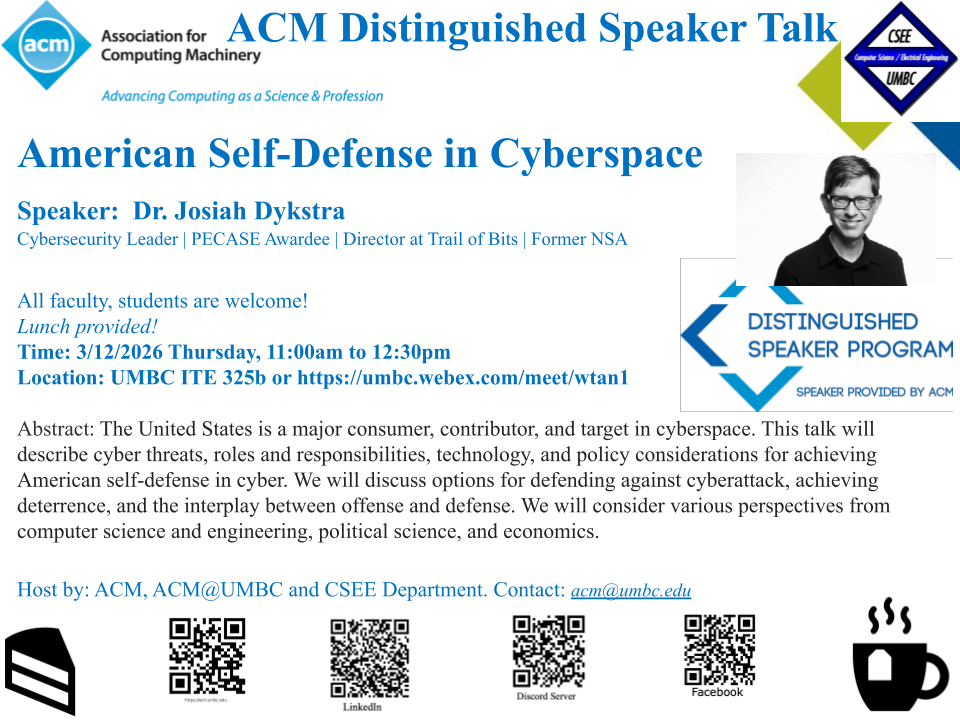
Location: UMBC ITE 325b or https://umbc.webex.com/meet/wtan1 Lunch provided!
Abstract
The United States is a major consumer, contributor, and target in cyberspace. This talk will describe cyber threats, roles and responsibilities, technology, and policy considerations for achieving American self-defense in cyber. We will discuss options for defending against cyberattack, achieving deterrence, and the interplay between offense and defense. We will consider various perspectives from computer science and engineering, political science, and economics.
Bio
Dr. Josiah Dykstra is the Director of Strategic Initiatives at Trail of Bits. He solves ambitious problems by blending high-end security research with a real-world attacker mentality to fortify the code powering the world’s most critical organizations and devices.
Dr. Dykstra previously worked for 19 years at the National Security Agency (NSA) where he advised leadership and employees on technical matters for integrated cybersecurity operations and provided technical direction on projects and programs that enabled high impact operational effects. He held a variety of technical and leadership positions including as a senior researcher within NSA’s Research Directorate studying computer network operations. His work has also included penetration testing, digital forensics, and malware analysis.
Dykstra is a Lifetime and Distinguished Member of ACM. He attended the 2nd Heidelberg Laureate Forum as a Young Researcher in 2014, which motivated his commitment to ACM. He is passionate about developing and empowering the next generation of interdisciplinary computing professionals, particularly in cybersecurity. Dykstra remains an active collaborator with academic, industry, and government researchers around the country. He has received numerous noteworthy awards, including the Presidential Early Career Award for Scientists and Engineers (PECASE). He is one of eight people in the CyberCorps Scholarship for Service (SFS) Hall of Fame.
Josiah received a B.S. in computer science and B.A. in music from Hope College (Holland, MI), M.S in information assurance from Iowa State University, and Ph.D. in computer science from the University of Maryland, Baltimore County. His doctoral research explored new technical and legal mechanisms to support digital forensics for cloud computing environments. Dr. Dykstra is a Fellow of the American Academy of Forensic Sciences (AAFS), member of the American Association for the Advancement of Science (AAAS), and member of the Human Factors and Ergonomics Society (HFES).
Dr. Dykstra is the author of the book Essential Cybersecurity Science (2016), a guide for practitioners and discusses key considerations for conducting scientific experiments in cybersecurity, including domain-specific insights including digital forensics and malware analysis. He is also co-author of the book Cybersecurity Myths and Misconceptions (2023). An experienced presenter and lecturer, he has spoken at major security events including Black Hat USA and RSA Conference.
Artificial Intelligence and Machine Learning in Manufacturing: An Overview
Speaker: ACM Distinguished Speaker Prof. Ram SriramChief, Software & Systems Division, NIST
Time: Feb. 6th 2026, Friday, 12pm to 1:30pm
Location: In Person: ITE 325b Lunch provided!
Abstract
Artificial Intelligence (AI) focuses on developing computer programs that emulate human intelligence and problem-solving strategies. Since its inception in the 1950s, AI has evolved through multiple waves—from knowledge-based expert systems, to neural networks and machine learning, and now toward a third wave that integrates learning with knowledge structures.
In this talk, Prof. Sriram will provide an overview of major AI methods and discuss their applications in the manufacturing domain, including expert systems, neural networks, and other machine learning techniques.
Bio:
Prof. Ram D. Sriram is the Chief of the Software & Systems Division at the National Institute of Standards and Technology (NIST)’s Information Technology Laboratory (ITL). He previously served on the engineering faculty at the Massachusetts Institute of Technology (MIT), where he founded the Intelligent Engineering Systems Laboratory and initiated the pioneering MIT-DICE project in collaborative engineering.
Prof. Sriram has authored or co-authored nearly 300 publications, including several books on Artificial Intelligence, and his work has received numerous best paper and most-cited paper awards. His honors include the NSF Presidential Young Investigator Award, the ASME Design Automation Award, multiple Lifetime Achievement Awards, and the IEEE Reliability Society Lifetime Achievement Award (2023).
He is a Fellow of ACM, IEEE (Life), AAAS, ASME, AIMBE, and several other professional societies, and currently serves as President-Elect of the Washington Academy of Sciences. Prof. Sriram has also held numerous national leadership roles, including chairing the IEEE Computer Society Fellow Evaluating Committee and serving on federal advisory and steering committees related to AI, software systems, and manufacturing.
Host: DaYuan Tan, James Baker, Weikan Tan, Rui Jin
Are you passionate about technology, eager to make a difference in our academic community, and ready to take on a leadership role?
The UMBC ACM Student Chapter is now accepting applications for its next executive team! We are currently seeking motivated individuals to fill the following positions: • President • Vice President • Secretary • Treasurer
Eligibility: To apply, you must be an active ACM member (student memberships start at just $19/year). We welcome all students who are enthusiastic about computer science, emerging technologies, and building a vibrant academic community.
Why Join? • A great opportunity to work closely with faculty and leading researchers • Gain leadership and organizational experience • Shape the direction of our chapter’s events, talks, and outreach • Be part of a team that supports innovation, learning, and collaboration
What We’re Looking For: • Willingness to organize and participate in ACM events • Strong sense of initiative and collaboration • Previous experience in event planning or student leadership (preferred but not required) • A desire to contribute to the growth of the ACM community at UMBC
To ensure a smooth transition, current officers will support and co-organize 1–2 events with the incoming team, passing on our experiences and best practices.
There is no fixed deadline — the application form will remain open until all positions are filled. However, applications will be reviewed on a rolling basis, and earlier submissions will be given priority.
We encourage all interested students to apply—this is a great opportunity to lead, grow, and make a meaningful impact.
If you have any questions, feel free to contact us via email: acm@umbc.edu.
Best regards, DaYuan Tan President, UMBC ACM Student Chapter acm@umbc.edu, dayuan1@umbc.edu
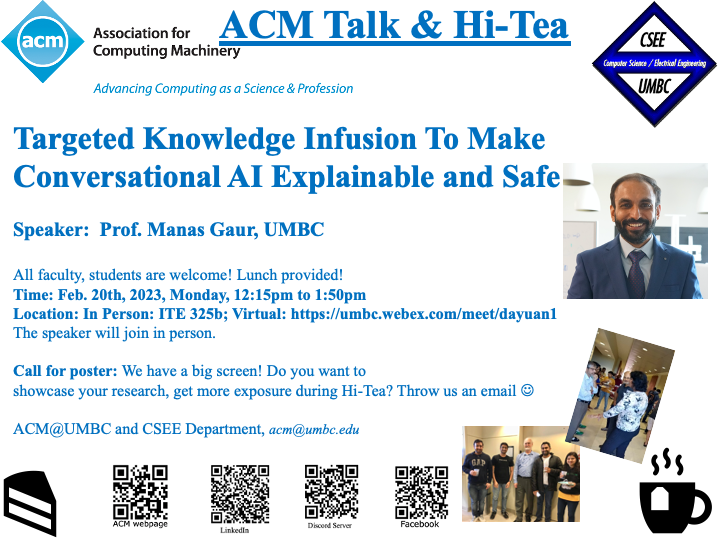
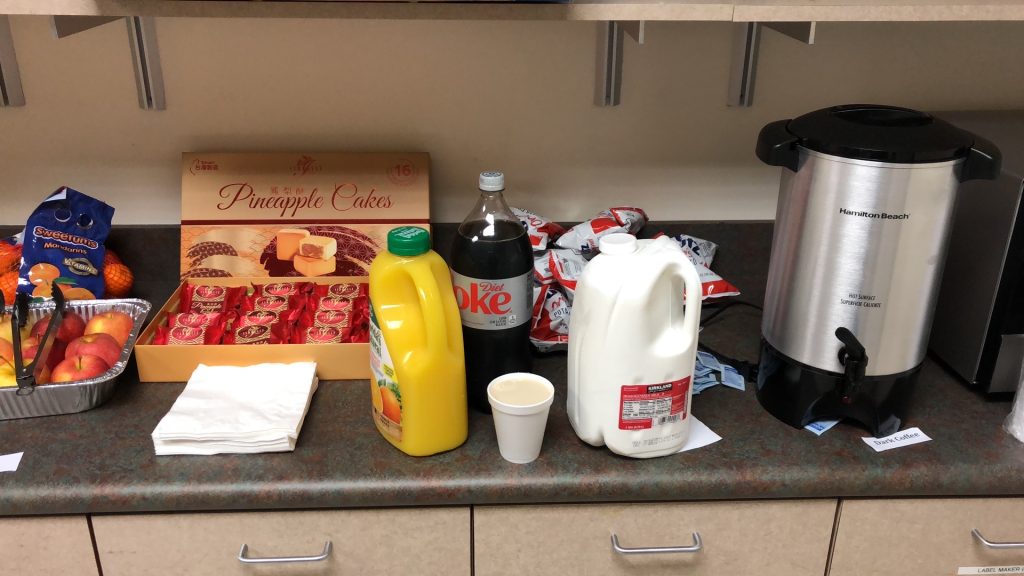
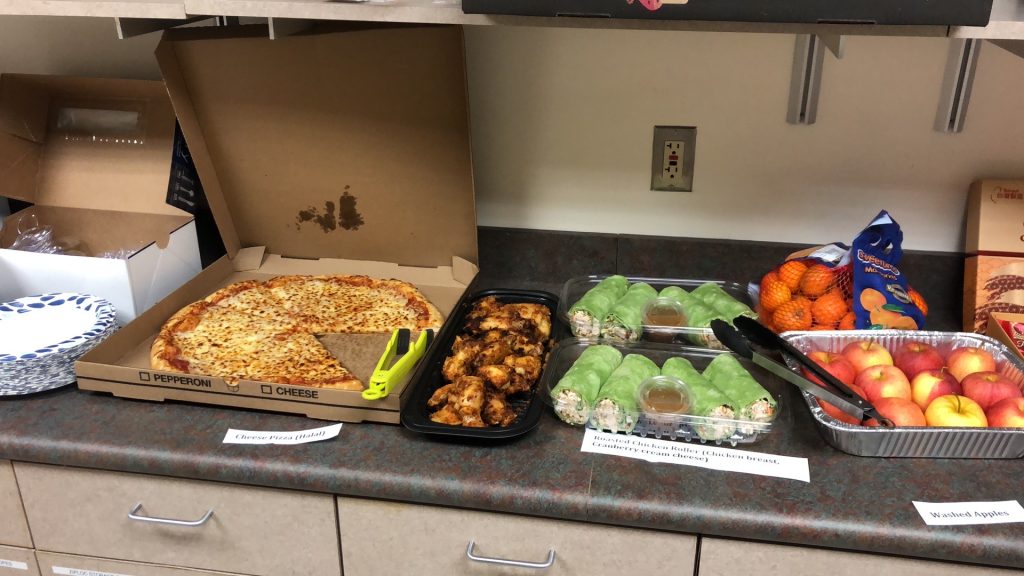
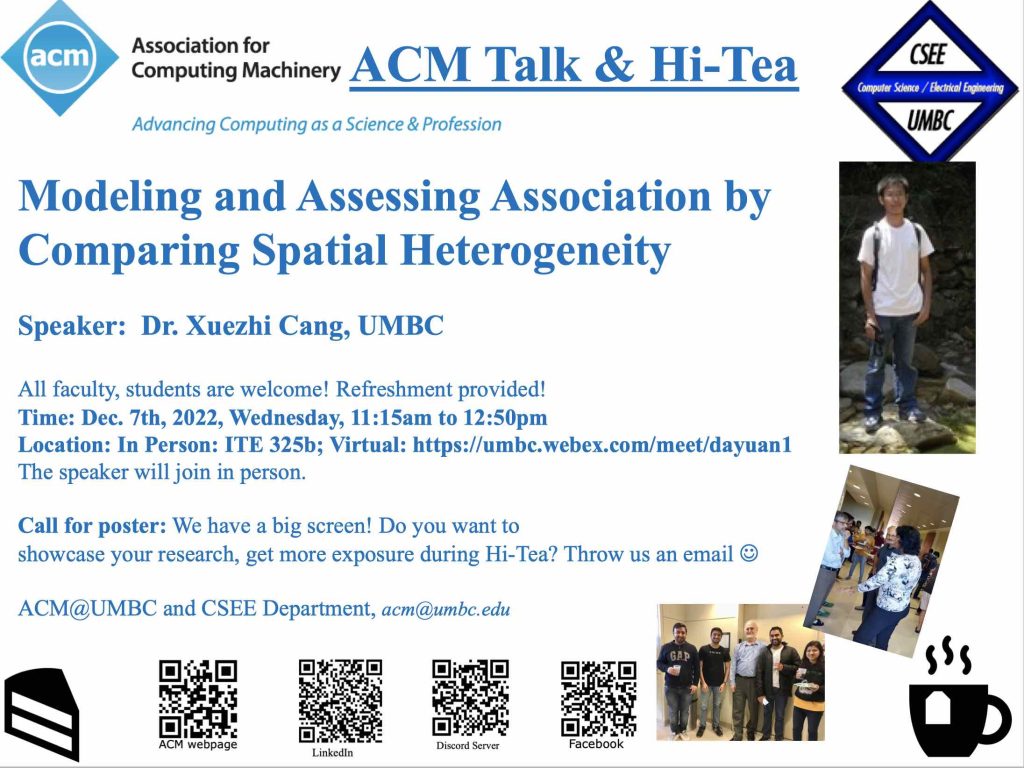
You are invited to ACM Talk & Hi-Tea! Join us to learn more and connect with faculty, staff, students and treat yourself to coffee, tea and snacks!
Location: In Person: ITE 325b (the speaker will present in person); Virtual: https://umbc.webex.com/meet/dayuan1 Time: Dec. 7th 2022, Wednesday, 11:15am to 12:50pm
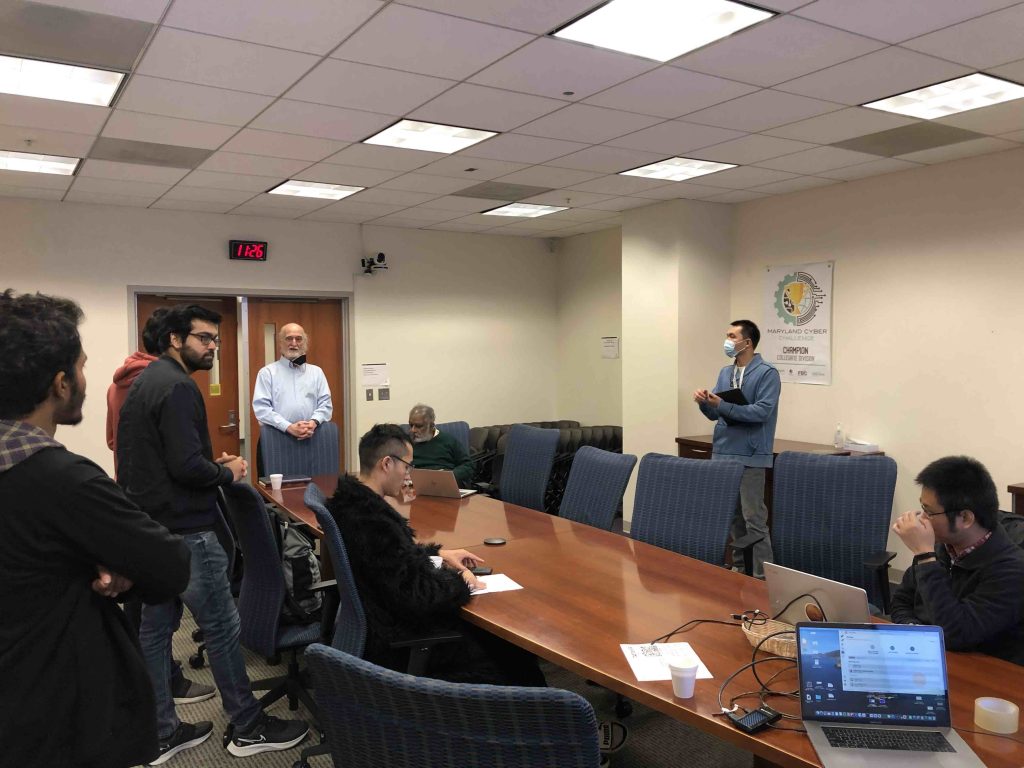
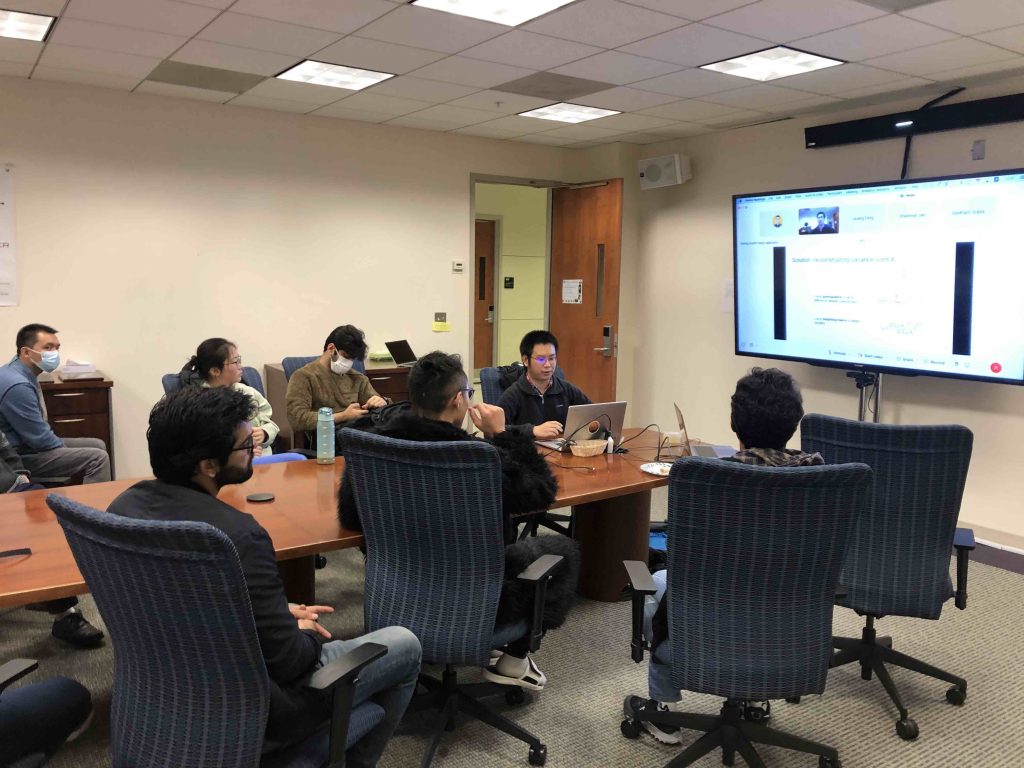
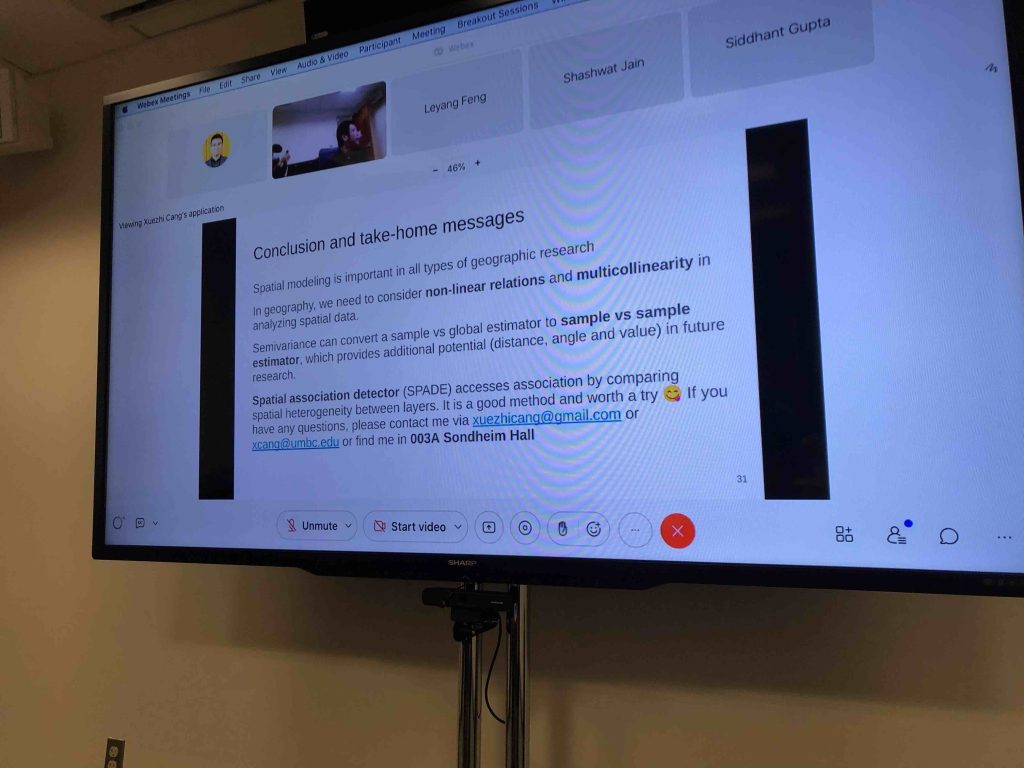
ACM Talk: Modeling and Assessing Association by Comparing Spatial Heterogeneity Speaker: Dr. Xuezhi Cang, UMBC. Abstract:Measuring spatial association between different spatial layers is important in spatial data modeling. Traditionally, the relationship between variables can be measured by linear regression. The assumptions of those traditional methods are hard to meet in the spatial data. Also, the traditional statistical methods do not consider Tobler’s First Law of Geography which is an important spatial data property. To address these drawbacks, I propose a spatial data association estimator (termed as SPatial Association DEtector, SPADE). By comparing the spatial heterogeneity, this estimator, which evolved from a variance-based relation estimator, explicitly considers the spatial variance by assigning the weight of the influence based on spatial distribution. It also overcomes the drawback of its old version which can only measure the association between continuous and discrete variables. This method has been applied to estimate the influence of the environmental factors and their outcome (e.g. junction angle and environmental factors). The associations between environmental factors and junction angles have been used to infer the paleoenvironment of Mars; they showed that Mars was probably “warm” and “wet” several billion years ago. The method could also be used in human geography and social science to estimate the importance of spatial factors and their outcome.
Please also check out our attached flyer. Sincerely,